
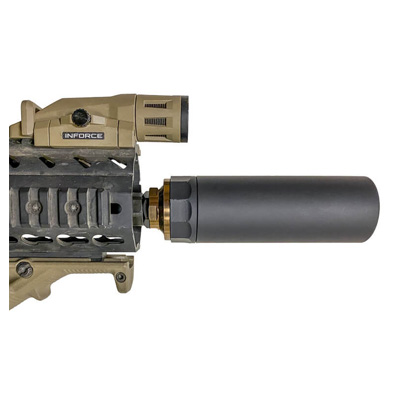
Suppressors, also known as silencers, are devices attached to the barrel of a firearm to reduce noise and muzzle flash. They are regulated under the National Firearms Act (NFA) and require compliance with specific federal and state laws.
At Appalachian Armory, we understand that navigating the suppressor purchase process can seem complex. This comprehensive guide will help you understand everything you need to know about purchasing suppressors, including tax stamps, trusts, and ATF regulations.
Important Update: On July 4, 2025, the "One Big Beautiful Bill" (H.R. 1) was signed into law, which will eliminate the $200 tax stamp requirement for suppressors, short-barreled rifles (SBRs), short-barreled shotguns (SBSs), and Any Other Weapons (AOWs). This change takes effect on January 1, 2026.
Until January 1, 2026, the $200 tax stamp remains mandatory for these items. It's important to note that machine guns and destructive devices are excluded from this provision and will still require the $200 tax stamp.
What This Means: While the tax stamp fee is being eliminated, the core NFA framework remains intact. Purchasers must still register suppressors with the ATF, undergo background checks, submit fingerprints and photographs, and comply with all applicable federal and state regulations.
Historically, purchasing a suppressor required a $200 tax stamp as part of the NFA process. This fee was established in 1934 and has remained unchanged for over 90 years. The tax stamp serves as proof that the tax has been paid and the item is properly registered with the ATF.
While the $200 tax stamp fee will be eliminated for suppressors, SBRs, SBSs, and AOWs, all other NFA requirements remain in place. You will still need to:
An NFA Gun Trust is a legal entity that allows multiple individuals (trustees) to legally own, possess, and use suppressors and other NFA items. Trusts offer several significant advantages over individual ownership:
One of the primary benefits of a gun trust is that multiple trustees can legally possess and use the suppressor without the primary owner being present. This is particularly beneficial for:
Important: Without a trust, only the individual owner can legally possess the suppressor. If someone else uses it without the owner present, they could face serious legal consequences.
A trust can significantly simplify the transfer of suppressors to heirs:
Without a trust, transferring a suppressor to an heir requires going through the full NFA transfer process again, including new forms, background checks, and potentially another tax stamp (until 2026).
Trusts offer additional benefits:
If you choose to use a trust, be aware that:
Note: We can help you understand the trust process and connect you with legal resources if needed.
Understanding the step-by-step process will help you navigate your suppressor purchase smoothly. Here's what to expect:
Select a suppressor that fits your needs, considering factors such as:
Important: Ensure suppressors are legal in your state. As of 2025, suppressors are legal for civilian ownership in 42 states, but state laws can vary significantly.
Decide between individual ownership or establishing a trust:
Consider your specific needs, family situation, and long-term plans when making this decision.
ATF Form 4 (Application for Tax Paid Transfer and Registration of Firearm) is required for transferring NFA items. The form must include:
We handle this for you: At Appalachian Armory, we complete all necessary paperwork in-house, ensuring accuracy and compliance.
Along with Form 4, you must submit:
We do this in-house: We provide fingerprinting and photo services at our location, making the process convenient for you.
After submitting your application, the ATF will:
Processing Times: Approval times can vary significantly, typically ranging from several months to over a year. The suppressor must remain at the dealer (our shop) until approval is received.
Status Checks: You can check the status of your application by calling the ATF NFA Branch.
Once approved:
Important: Always carry a copy of your approved Form 4 when transporting the suppressor, as it serves as proof of legal ownership.
The Bureau of Alcohol, Tobacco, Firearms and Explosives (ATF) oversees the regulation of suppressors under the National Firearms Act. Understanding these regulations is crucial for legal compliance.
All suppressors must be registered with the ATF using the appropriate forms:
All purchasers must pass a background check, which includes:
Suppressor ownership is subject to state regulations:
Georgia Law: Suppressors are legal in Georgia for civilian ownership when properly registered with the ATF.
You cannot purchase a suppressor if you:
Choosing between individual and trust ownership depends on your specific situation. Here's a comparison to help you decide:
| Factor | Individual Ownership | Trust Ownership |
|---|---|---|
| Initial Setup | Simpler - just personal information | More complex - requires trust document and all trustees' information |
| Shared Access | Only the owner can possess | All trustees can possess and use |
| Estate Planning | Requires new transfer process for heirs | Simplified transfer to beneficiaries |
| Background Checks | Only the owner | All responsible persons (trustees) |
| Fingerprints/Photos | Only the owner | All responsible persons |
| Privacy | Registered to individual | Registered to trust |
| Flexibility | Limited - only one owner | High - can add/remove trustees |
At Appalachian Armory, we make the suppressor purchase process as smooth and stress-free as possible. Our services include:
We handle all ATF forms and documentation, ensuring accuracy and compliance with all regulations.
We provide fingerprinting services in-house, so you don't need to go elsewhere for this requirement.
We take the required passport-style photographs on-site, making the process convenient for you.
Our knowledgeable staff will guide you through every step of the process and answer all your questions.
We ensure all documentation meets ATF requirements and is submitted correctly to avoid delays.
We securely store your suppressor at our facility until ATF approval is received.
A: Processing times vary but typically range from 6-12 months, sometimes longer. The ATF processes applications in the order they are received. You can check the status of your application by calling the ATF NFA Branch.
A: Yes, as long as the suppressor is rated for the caliber and the firearm is compatible. However, you must ensure the suppressor is properly rated for the caliber and pressure of each firearm you use it on.
A: Yes, each suppressor requires its own tax stamp (until January 1, 2026) and Form 4 application. However, you can submit multiple applications at the same time.
A: Yes, but you must first obtain approval from the ATF using Form 5320.20 (Application to Transport Interstate or to Temporarily Export Certain National Firearms Act Firearms). This form must be submitted in advance and approved before transporting.
A: If your application is denied, the tax stamp fee (if paid) is typically can be refundable.
A: Yes, but you must first obtain approval using ATF Form 1 (Application to Make and Register a Firearm) and pay the tax stamp (until January 1, 2026) before beginning construction. Building a suppressor without proper approval is a serious federal crime.
We're here to help you through every step of the suppressor purchase process. Whether you're interested in individual ownership or setting up a trust, our experienced team will ensure everything is done correctly.
This information is provided for educational purposes only and should not be considered legal advice. Laws and regulations regarding suppressors can change, and state laws vary. Always consult with qualified legal professionals and verify current ATF regulations before making any purchases or decisions regarding NFA items.
For official ATF information, visit: www.atf.gov/firearms
©2026 Appalachian Armory by Black Cloud Apps LLC